Drawing FacesHow to Draw the Face | |||||||||||||||||||||||||||||||||
Sketching faces with charcoal (using brush techniques)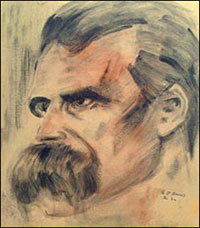
Originally written Jan 2004. Copyright ArtGraphicA.net Notes: Some of the source material is permanently missing, and screenshots are salvaged largely from the original compressed videos (no longer in existence). Like the previous Figure Drawing Lesson - female figure in charcoal this free art lesson on drawing faces again uses charcoal and a brush, though this time the water is added to charcoal particles, a red earth-like pastel is used, and the paper is prepared before use.
How to Sketch Faces in Charcoal - Free Portrait DemoEquipment 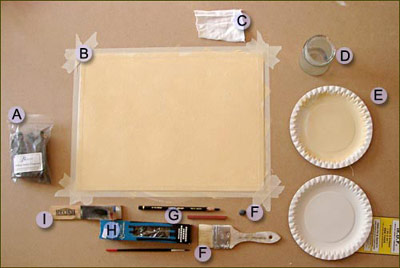
Paper Preparation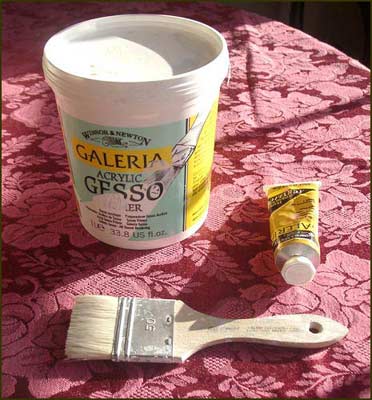 Paper is completely a personal choice. I used a 40 cm by 30 cm sheet of thick watercolour paper, but acrylic gesso has a tendency to warp even tough paper, and so before I began I filled up the bath tub and let the sheet soak for five minutes. Next, I turned the sheet over and gave it another five minutes or so before pulling it out of the tub, giving it a quick and gentle wipe with a towel, and laying it down onto a rigid sheet of MDF board (use whatever you like - Masonite, foamboard - any rigid support should do). Working quickly I taped the four edges of the paper with masking tape, adding extra tape across the corners as there is a danger that when the paper dries, it will break free of the tape. A quick word about acrylic gesso for those who do not know about this paint. There are many brands available, you need only pop down to your local art shop, or order online. For those new to art, art shops can be a little intimidating with so many unknown products on the shelves. I recall my first visit to an art supply chain, and as I wandered amongst the alien shelves, filled with so many unknowns, I could sense the eyes of artists aware of my inexperience as I awaited the cries and jeers of, 'he's not a real artist. Intruder! - throw him out!!' I had vaguely heard about odourless turpentine, and so approached the shop assistant and asked if they had any. She mouthed the word back to me "odourless?" as though I had tried to order an Indian take-away, and I recall thinking, oh god I've just asked for a fictional product! She had not heard of the product, and so asked the shop manager. I stood there contemplating whether to make a run for it and never showing my face in their establishment again, however, before the flight response kicked in, the manager looked at me, and said, 'yes we have some on the shelf over here'! I picked up a bottle, handed it to the shop assistant, smiled, possibly with just a faint trace of smugness, for I was now an expert in art materials! Anyway, back to gesso!!... The paint is fairly inexpensive, and used extensively by oil painters in preparation of their canvases (if oil paint comes in contact with canvas, wood or paper, the surface will eventually rot). I decided to use acrylic gesso, in part to add more tooth and texture to the paper, and also that I might tint the colour with a little added yellow ochre acrylic paint. 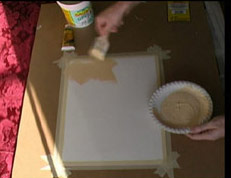 Applying Gesso to PaperHere I apply the gesso to the paper with a crisscross motion of the hand until it is covered up to the edges of the masking tape. 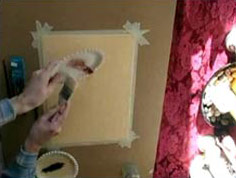 Toning the PaperHaving ground the red pastel and charcoal into dust, I decided to use the same large bristle brush I used to apply the gesso, to spread the dust particles around. Although it may vaguely look like I know what I am doing, it is all rather haphazard, and my only real forethought and intention at this moment, is to roughly place the red dust within the general area of the face.  The Brush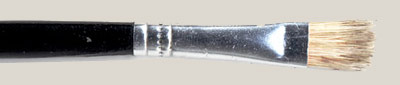 Just a quick mention of the brush I use for the majority of the following work. It is a oil painting bristle brush, bought from "The Works" bookshop, and made by Crimson and Blake. It is possibly the cheapest brush you can buy, but the hairs seem to stay fixed (although the handle shed its thin veneer of paint within a day!), and it lends itself ideally to any messy charcoal particles and creating the sketchy textures that make up the shading of the face and hair. Lesson continues, follow link below... Click to View PART TWO of DRAWING THE FACE
| |||||||||||||||||||||||||||||||||


 |