PENCIL DRAWING TIPSLandscape Pencil Art Lesson |
||||||||||||||||
Pencil Drawing Tips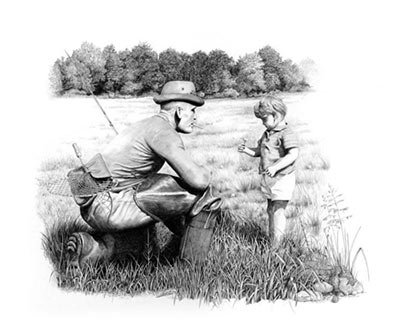
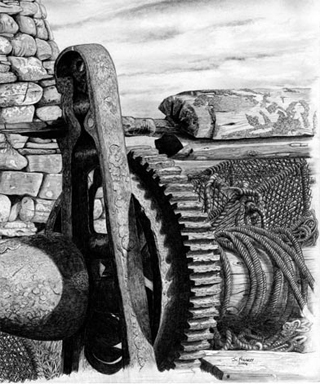
The Fishermen by Jim Fogarty
Most of the limited information and techniques briefly outlined here are probably already used - in one form or another - by the majority of people working in pencil. But here are the few very basic drawing tools that I personally work with and tend to use for my own pencil drawings. PencilsSome pencil artist today prefer to work with mechanical draughtsmans style pencils. These mechanical pencils have numerous advantages over regular pencils. They are a constant length and so a constant balance, the leads are more regular and they don't need sharpening as such. 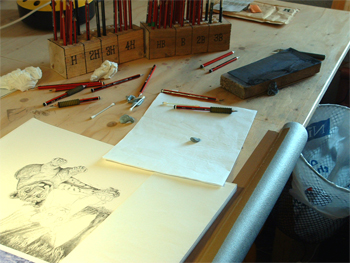
The arguments for using mechanical pencils make a lot of sense. But then again, doing what makes sense has never really been my strongpoint and with me old habits die hard. Personally, I have always drawn with regular wooden pencils, mostly 'Staedtler Tradition' and 'Derwent Graphic' pencils, ranging in hardness from 7H (Very hard) to 7B (Very soft), HB being about midway between the two. They are what I have become used to and whilst the chore of sharpening 'umpteen' pencils at a time can be a pain, there does seem to be something vaguely 'workmanlike' about the whole process. I also sharpen my pencils with a scalpel as opposed to a pencil sharpener, it maybe takes slightly longer, but this way I find I can get exactly the profile of lead that I want - impossible with a pencil sharpener. This is certainly not necessarily the best way to work and I wouldn't dream of suggesting to anyone else that they should do the same, it's just what I personally have gotten used to doing. Other Useful 'Bits'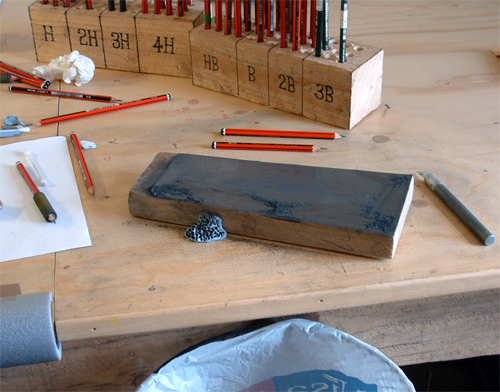
As well as the pencils and whatever paper or board I'm using when drawing, there are a few other items that I always try to have at hand before I start. By far the most used pieces of kit that I have are my trusty 'wet and dry' boards. These are simply pieces of wood or hardboard with 'wet and dry' fine grit paper glued onto them. These file boards are used to maintain a needle sharp point on my pencils, this being essential for really fine work. Another useful byproduct of my 'frantic filing' is the build up of graphite powder on these boards - very useful for rendering clouds, or large areas of smooth shading like the sky or background tones. I usually apply this graphite dust with either cotton wool, or applied with the tip of a cotton bud for shading smaller areas. Cotton wool and cotton buds also work very well on graphite applied with a pencil for smoothing or fading the edges of previously shaded areas. Obviously different tones being achieved by using different grades of graphite dust, just the same as using the pencils. My fileboard - basically, just a bit of wood with with a piece of wet and dry paper glued onto it! Note the graphite dust - useful for clouds and large areas of shading. A little blob of Blu Tack in each corner keeps the board from moving about - yet another blob of Blu Tack is used here for cleaning excess graphite off of the pencil tip after filing. 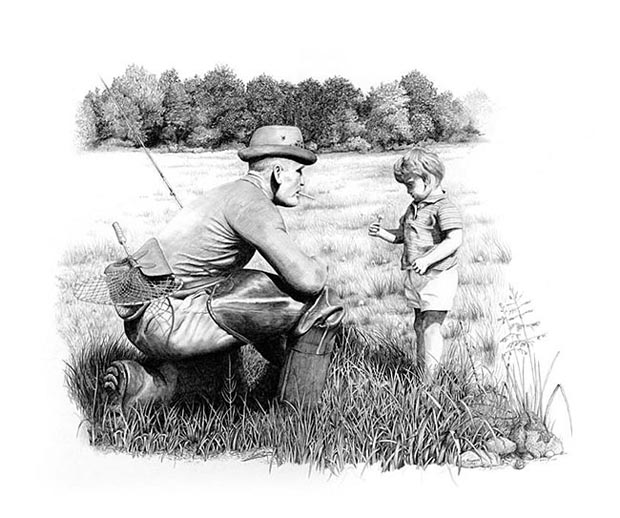
This drawing was taken from an old black and white photograph of my Father and a very 'young' Me (no-where near as cute as this anymore!). It took about a week or so to complete and was drawn on A2 size paper. The original 12cm x 10cm photograph (taken with an old Box Browny) was quite over-exposed in places. This added to the feel of photograph so I drew it out the same way.
Applying a lump of Blu Tack to graphite actually lifts the graphite off the paper without damaging the papers' surface at all. This is very useful, not only for removing general mistakes, but also for creating highlights on already shaded areas. Blu Tack is an invaluable 'get out of jail free card' when drawing and certainly worth a play if you're not already familiar with it. Basic TechniquesHere again, most people having used pencils to draw for any time will already have developed their own personal techniques and ideas. But here are the most valuable lessons regarding pencil drawing, that I personally, have learnt over the years. Always draw out 'light' to start with. I tend to use an HB pencil to draw out my initial, very light outlines. Use minimal pressure and make your lines just heavy enough so that you can see them - that way if you make a mistake or have to adjust something - you can, without leaving deep indentations in your paper. 
Wherever possible avoid 'outlining' the various parts of your drawing with hard drawn edges (unless of course they actually are hard edges!). Once you have roughed out your drawing and you are starting to fill in the details, erase your initial lightly drawn outlines (obviously only on the part you are directly working on) and then try and re-create your outline by contrasts of light and shade, textures, or different styles of applied shading - without where possible, resorting to a hard pencil line (that in reality probably isn't actually there anyway). A classic example of this is when drawing the feathered outline of birds, or the fur on the outline of animals. When you have your initial outline and you are then filling in the detail on your animal or bird, use lots of smaller lighter lines running in the natural direction of the fur, or feather on the animal or bird - as opposed to one continuous drawn outline - it gives a far more realistic, softer and natural outline. 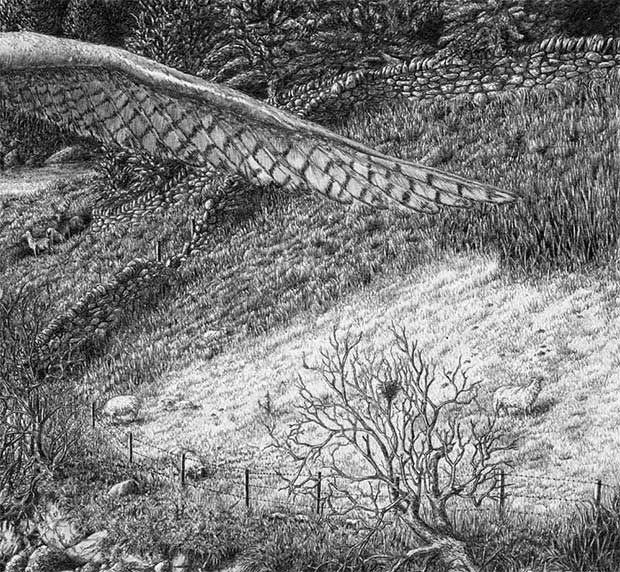
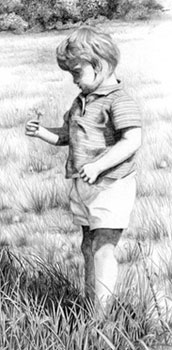
Detailed View Always avoid resting your hand on the surface of your paper wherever possible. Your hands - no matter how particular you may be about washing them - will always be slightly greasy. Where possible I always use a second piece of paper to rest my hand on, avoiding contact with my actual drawing surface whenever it's practical to do so. Keeping your paper clean this way, in my experience helps greatly if you maybe need to erase applied graphite later (any grease or moisture from your skin effectively binding the graphite into the papers surface - making it harder to erase cleanly). Never use your finger to smooth out shaded areas on your paper. Always use something dry to work applied graphite. You can buy proper tools for this purpose, but I tend to use cotton wool for larger areas of smoothing and cotton buds for smaller areas. Never use your fingers! Always try to avoid resting your hand on areas already worked. Being right handed I try to work from left to right and top to bottom on my drawings. Whilst this is not always practical - using this principle as far as possible will help keep your drawing smudge free. On occasions however, resting on already worked areas is unavoidable. By using your second piece of paper as a rest for your hand however, you can get away with overworking previously drawn or shaded areas. Just ensure that once your 'rest' paper is laid on your work, you don't then, inadvertently drag it over the surface of your drawing. Lay it down, rest on it, lift it when necessary, then lay it down again, work on it again and so on - never drag it, as this can smudge any soft graphite applied underneath the paper, just as your hand would. Always keep your harder (detail) pencils sharp. There is just no way that you can apply fine detail to a drawing with blunt pencils. I sharpen my pencils with a scalpel and then shape the lead with my file boards; this gives me a really fine point for that finest detail. Always wipe the end of your pencil after sharpening. Particularly if you use a file board - but even if you just use a normal pencil sharpener - wipe the sharpened end of your pencil with a piece of kitchen or toilet roll before using it on your drawing again. You will always get residual grains of graphite that will stick to the sharpened surface of your pencil, these can ruin a finely drawn line, so wipe them off before using the pencil again. Never use a 'hard' rubber on your paper if you can avoid it. All a hard rubber does is effectively 'rip' off the top layer of your drawing paper, taking your mistake with it. This ruins the smooth surface of your paper and whilst you may have removed your mistake - you've also removed your drawing surface. Redrawing or shading over that damaged surface will be very difficult. If you must use a rubber - use a putty rubber, but better by far is to use Blu Tack. Blu Tack lifts the graphite off the surface of the paper without damaging it. The more times Blu Tack is applied to a graphite line, or area of shading, the lighter that line will get. Always clean up your work once it's finished. Once your drawing is complete clean any smudges on the paper around your work using either a putty rubber or Blu Tack, but do take the time to clean up your page before sealing your work with fixative. By removing any unintentional smudges off of your drawing, it makes it look cleaner, better defined and generally more professional. 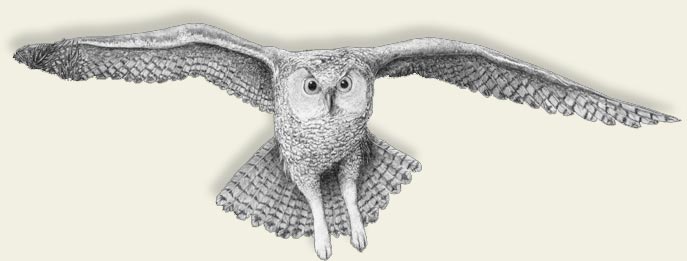
Always seal your finished pencil drawing. Once you're certain that your drawing is complete - seal it. Graphite pencil will smudge if rubbed or touched, so seal it in with a sealing or fixative spray (Available at art shops). An alternative is a 'perfume free' firm hold hairspray - hairspray does exactly the same thing as 'proper' fixative sprays - and is cheaper too. Spray these 'fixatives' on lightly though. Too heavy an application can cause a slight loss of really fine detail with graphite work. Several light applications generally work best. Be aware though - once your work is sealed you will be unable erase any mistakes. So make sure it is right before you seal it! If you draw yourself you will no doubt already be well aware of most of what is written above, actually much of it is just common sense really. I certainly don't profess to be any kind of drawing expert, these observations are based purely on my own limited drawing experience..............and lots of mistakes. They do however, work for me, so hopefully there may be something in the information above that may be useful to you. 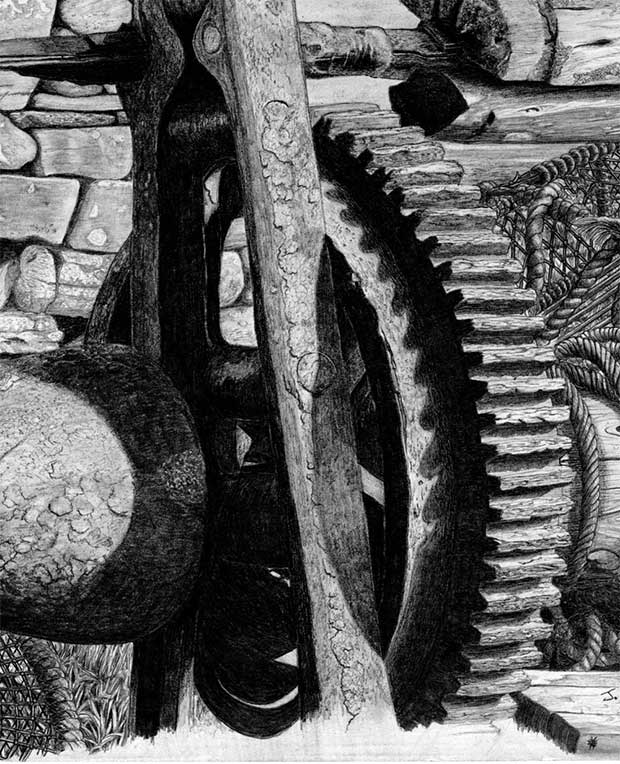
Detail Visit Jim Fogarty
| ||||||||||||||||


 |